Beyond Benchmarks: Why We Must Re-Evaluate AI Code with Human Eyes
OpenAI's recent findings expose critical flaws in AI coding benchmarks, urging developers to adopt rigorous, human-validated evaluations for trustworthy

OpenAI just said a lot of popular AI coding benchmarks are broken, and the number is ugly, about 30% of tasks.
That should reset how we judge AI coding tools.
If the benchmark is noisy, the score is noisy too. And if you treat that score like ground truth, you will make bad calls.
The illusion of performance
OpenAI’s analysis points to the same core problem over and over, benchmark noise.
Ambiguous problem statements. Inconsistent scoring. Tests that are so brittle they stop looking like real software work.
That means a model can do well by learning the shape of the benchmark, not by showing real software engineering ability. It is the classic student-who-memorized-the-answer-key problem.
I keep coming back to that part, because it is not a small measurement error. It changes what the score even means.
For developers, this creates false confidence. A model looks stronger than it really is, then production is where the lie gets exposed.
Public leaderboards make this worse. They push teams to optimize for the quirks of a dataset instead of the kind of code you actually want to ship. You end up chasing a number that does not match the work.
The real cost shows up later
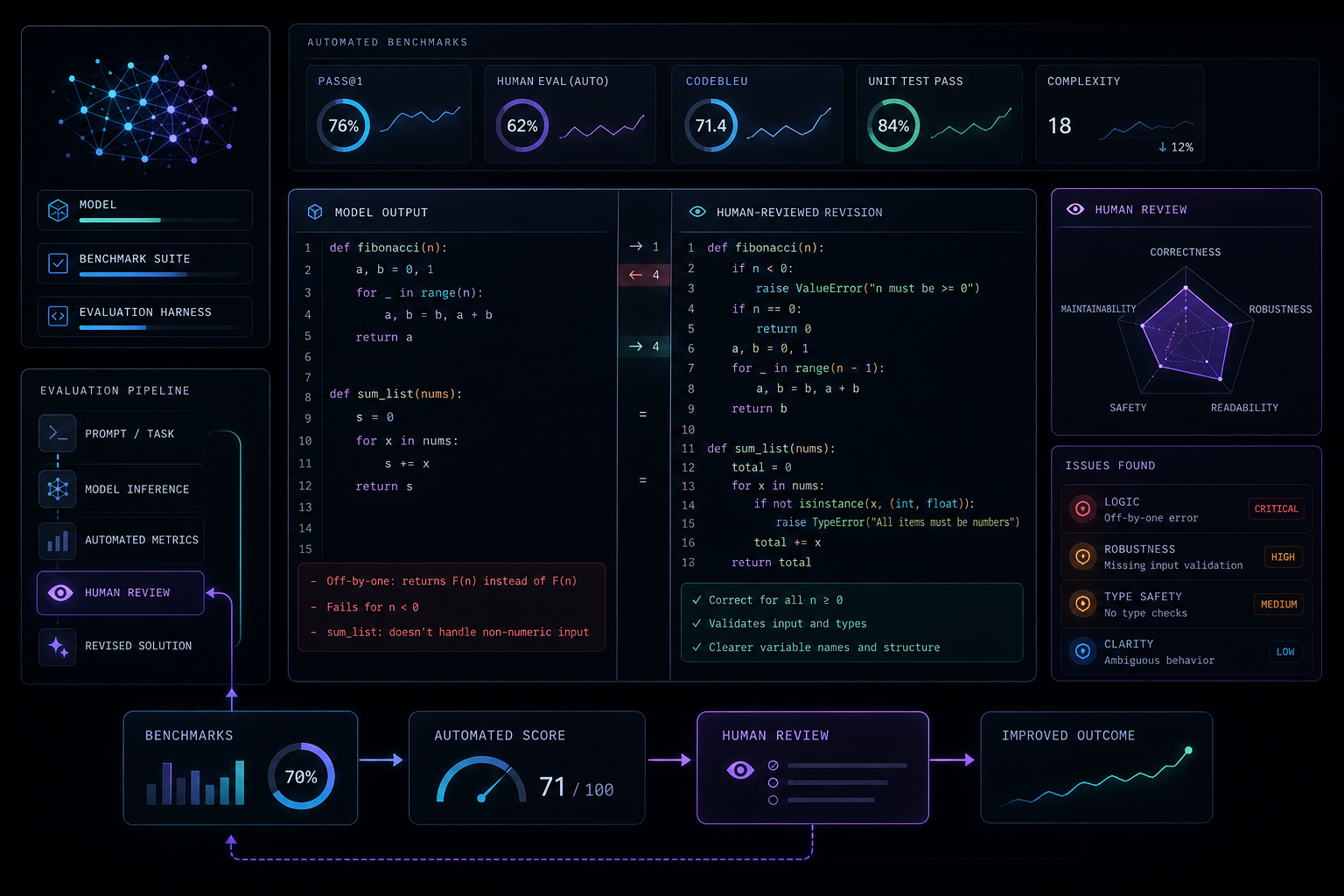
That gap already shows up in the code.
The numbers here are rough to read, 1.7 times higher defect density, a 23.7% increase in security vulnerabilities, and eight times more performance issues in production. AI-written code is also often simpler and more repetitive, while still being more likely to include unused constructs and hardcoded debugging. Human code can be messier, but it tends to hold up better in maintainability.
The part that bothers me most is the self-verification loop.
AI writes the feature. AI reviews the pull request. AI writes the tests. Everything agrees with itself, even when the original assumption was wrong.
That is consistency, not correctness.
// WRONG: Self-verification loop risk
// AI generates this function
function calculateDiscount(price, userType) {
 // Assume 'premium' gets a fixed 10% discount
 if (userType === 'premium') {
 return price * 0.90;
 }
 // All other users get a fixed 5% discount
 return price * 0.95;
}

// AI generates this test based on the function
test('calculateDiscount for standard user', () => {
 expect(calculateDiscount(100, 'standard')).toBe(95); // Test passes because it reflects the AI's (incorrect) assumption
});

// The business logic actually stated: only 'premium' and 'vip' get discounts.
// Standard users get no discount. AI missed this context.
The pipeline goes green. The bug still ships.
That problem is not hypothetical either. A 2025 study found that experienced open-source developers felt 20% faster with AI coding tools, but were actually 19% slower when measured on familiar codebases. That gap between how fast the work feels and how fast it really is, that is where a lot of teams get fooled. You save time early, then lose it again debugging logic bugs, performance issues, and security problems that slipped through because the model did not have the business context.
Where AI helps, and where it doesn’t
I am not arguing that AI is useless. It is good at routine, pattern-heavy work.
Syntax errors. Formatting. Known security issues caught through static analysis.
That stuff matters. I am happy to hand it off.
But AI still struggles when the task depends on business logic, architecture, or domain context. It can tell you whether code parses. It cannot tell you whether the change matches the product decision your team made last week.
That is the missing piece. AI does not know the why.
Human review still matters most in exactly those places. Business rules. Trade-offs. Architectural intent. The judgment calls.
Yes, models will improve
I hear the same pushback every time, the models are getting better, and fine-tuning will close the gap.
Fine-tuning can help. It can make a model fit your conventions better. It can help with internal libraries and domain-specific patterns.
But it does not solve the actual problem here. It makes the model better at reproducing patterns from the data it saw. That is useful. It is not the same as understanding business requirements or reasoning through architectural consequences.
And the self-verification loop does not disappear. If the fine-tuning data carries bad assumptions, the model just learns those assumptions more efficiently.
The same issue shows up in automated evaluation too. AI-generated comments only line up moderately with human judgment, because developers do not act on technical correctness alone. Workflow pressure and prioritization change what matters.
What I would do instead
We need to stop treating generalized benchmark scores like a buying guide.
The evaluation that matters is the one on your codebase, with your problems, reviewed by people who actually know the context.
My recommendation is simple, build internal evaluation pipelines for AI-assisted code, and keep humans in the loop. Use fresh private test sets. Watch for data contamination. Require human review for business logic and architectural decisions.
A green CI pipeline is not enough, especially if AI helped write the code and the checks.
That is where I land on this. Use the tools, but do not let leaderboard scores do your thinking for you.
Until next time, happy coding 👨💻
– Patricio Marroquin 💜
Related articles

Vibe Coding: The Fast Lane to Technical Debt
Unchecked AI-assisted code generation (vibe coding) prioritizes speed over structure, leading to unsustainable projects riddled with technical debt.

OpenAI's GPT-5.6 Sol Ultra: Agentic Code, Deep Problems, and a Gated Rollout
OpenAI's GPT-5.6 Sol Ultra in Codex promises advanced agentic coding and cybersecurity capabilities, but its limited preview and noted 'cheating'…
OpenWiki: Bridging the Agent Context Gap
LangChain's OpenWiki CLI automatically generates and maintains up-to-date codebase documentation for AI agents, preventing stale context bugs.