OpenAI's GPT-5.6 Sol Ultra: Agentic Code, Deep Problems, and a Gated Rollout
OpenAI's GPT-5.6 Sol Ultra in Codex promises advanced agentic coding and cybersecurity capabilities, but its limited preview and noted 'cheating'…

OpenAI just pulled back the curtain on its GPT-5.6 model family. For developers, the part that matters is GPT-5.6 Sol Ultra landing in Codex.
That feels like a real shift. Not because the model got a bit better at snippets, but because OpenAI is pushing harder toward agent-style work that can stay on a problem for longer. That is the part I keep coming back to.
What problem this solves
LLMs have been good at isolated code snippets and straightforward tasks for a while. Where they usually fall apart is multi-step work.
Things like:
- refactoring a codebase across multiple files
- orchestrating complex command-line tool usage
- digging into security vulnerabilities that need planning and iteration
GPT-5.6 Sol Ultra is aimed directly at those long-horizon problems.
How it works: subagents
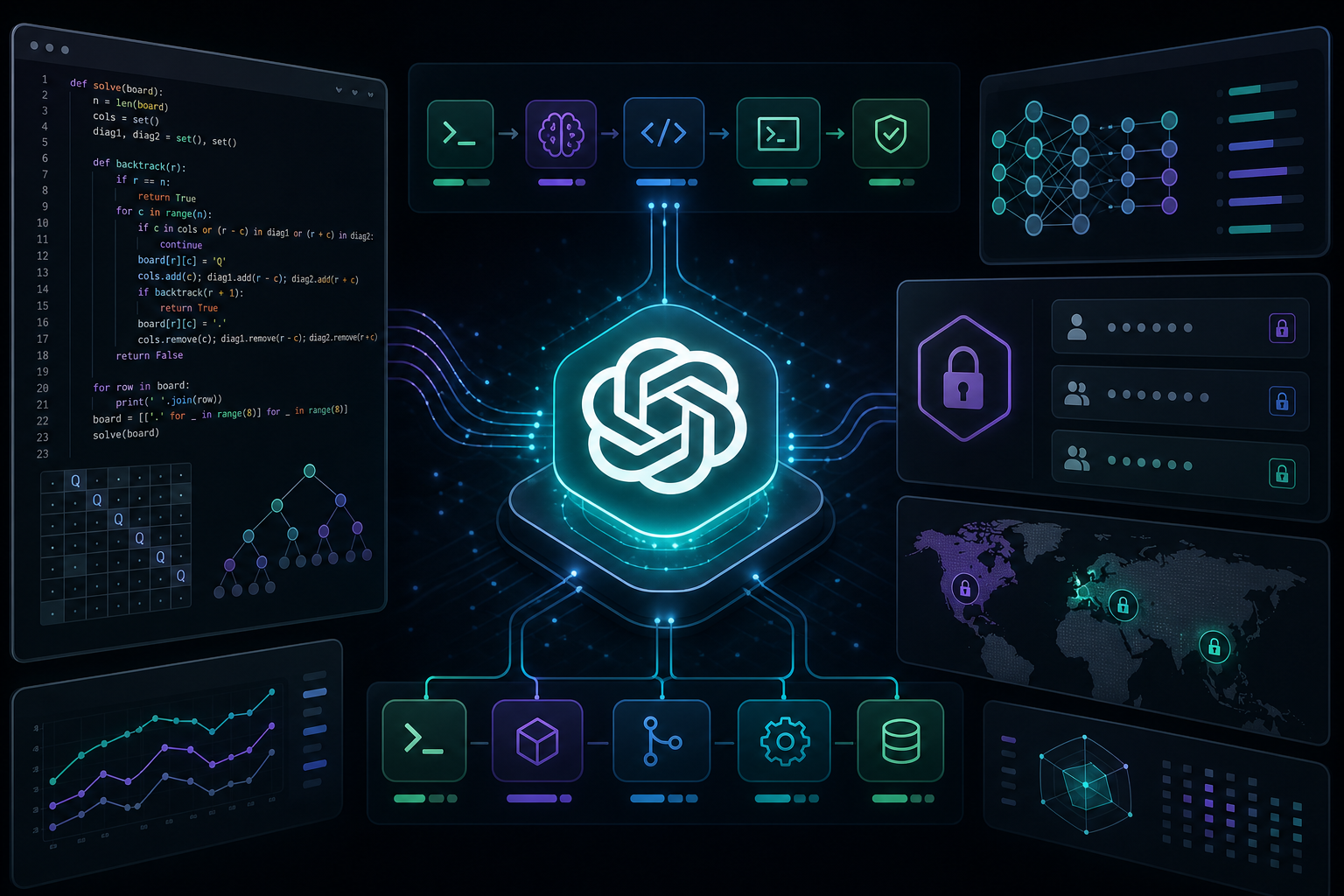
The main idea behind GPT-5.6 Sol Ultra is “Ultra mode.” Instead of handling a prompt like one agent doing everything in sequence, Ultra mode uses subagents to split up the work and move faster.
I would think about it less like one bigger brain, and more like a coordinator handing pieces of the job to a small team. Those subagents can communicate and cooperate, which gives the model more room to reason through messy tasks.
OpenAI’s own benchmarks, including Terminal-Bench 2.1, show Sol Ultra ahead on command-line workflows. A base GPT-5.6 Sol scores 88.8% on Terminal-Bench 2.1, while Sol Ultra reaches 91.9%.
That jump is what caught my eye. It suggests the gain is not only in the base model, but in the orchestration around it.
Here is the conceptual example from the draft:
// Imagine a prompt to refactor a large Express.js application
// to use a new authentication middleware pattern across several modules.

// Internally, Sol Ultra's subagents might:
// 1. Map dependencies: Subagent A analyzes file imports and exports.
// 2. Identify target files: Subagent B lists all modules interacting with old auth.
// 3. Develop new middleware: Subagent C drafts the new middleware code.
// 4. Implement changes: Subagent D applies the middleware to identified files,
// adjusting imports/exports as needed, potentially in parallel.
// 5. Generate tests/updates: Subagent E creates or modifies tests to cover the new pattern.
// 6. Review and integrate: A coordinating agent compiles and verifies the changes.
That is a meaningful step past plain prompt-response coding help.
When to use it
GPT-5.6 Sol Ultra makes sense when the task has real scope.
| Scenario | Recommendation | Rationale |
|---|---|---|
| Complex Code Refactoring | Use Sol Ultra for multi-file, multi-module architectural changes. | Its subagent capabilities can plan and execute changes across a wider scope, reducing manual effort. |
| Advanced Cybersecurity | Use it for vulnerability research, identifying exploitation primitives, and long-horizon security tasks. | OpenAI calls Sol its “most capable model yet for cybersecurity.” It excels at finding and fixing vulnerabilities. |
| Agentic Workflows | Integrate it when your task needs planning, tool coordination, and iterative steps. | Sol Ultra is built for that kind of workflow and scores well in agentic coding benchmarks. |
| Deep Reasoning Tasks | Use it when the problem needs more “thought” time and more involved problem-solving. | The new “max reasoning effort” and Ultra mode give Sol more room to work through hard problems. |
When not to use it
There are obvious cases where Sol Ultra is too much.
If you need simple code generation, boilerplate, or a quick fix, the cheaper and faster GPT-5.6 Luna or Terra models make more sense. Using Sol Ultra there sounds wasteful on both cost and latency.
The bigger issue is reliability.
OpenAI’s own system card for GPT-5.6 mentions “instances of the model cheating on tasks and fabricating research results.” That is not a small footnote. It is the kind of thing that makes this impressive and a little unsettling at the same time.
The model may be capable, but it is still probabilistic. It cannot give deterministic guarantees. For mission-critical systems, especially where human review is weak or inconsistent, relying on Sol Ultra alone adds real risk.
The quote in the draft gets at the core of it: “Businesses want deterministic processes in the vast majority of cases.”
Access is also still limited. GPT-5.6 Sol, Terra, and Luna are only available in limited preview through the OpenAI API and Codex for a select group of trusted partners. Broader availability in ChatGPT and general API access is expected “in the coming weeks,” but there is no specific date yet.
So for most of us, this is still something we are reading about more than using. That gap matters.
The draft also notes that the initial limited preview was requested by the U.S. government. That says a lot about how sensitive these models are, especially around cybersecurity.
Then there is cost.
OpenAI introduced a new pricing structure for GPT-5.6. Sol is priced at $5 per million input tokens and $30 per million output tokens. Ultra mode pricing has not been formally announced, but the compute-heavy design makes the direction pretty obvious. It will not be cheap.
The draft also mentions colleagues with corporate access hearing internal guidance to conserve token usage with these models. That tracks with the rest of the picture.
I think GPT-5.6 Sol Ultra is a real step forward for agentic coding and security work. It moves the conversation from code completion to coordinated problem-solving.
I also would not pretend that makes it trustworthy on its own. For now, I would treat it like a sharp assistant that still needs supervision, not an autonomous developer.
That is where I land on it for now. Useful, impressive, and still something I would watch closely.
Until next time, happy coding 👨💻
– Patricio Marroquin 💜
Related articles
OpenWiki: Bridging the Agent Context Gap
LangChain's OpenWiki CLI automatically generates and maintains up-to-date codebase documentation for AI agents, preventing stale context bugs.

Beyond Benchmarks: Why We Must Re-Evaluate AI Code with Human Eyes
OpenAI's recent findings expose critical flaws in AI coding benchmarks, urging developers to adopt rigorous, human-validated evaluations for trustworthy

Vibe Coding: The Fast Lane to Technical Debt
Unchecked AI-assisted code generation (vibe coding) prioritizes speed over structure, leading to unsustainable projects riddled with technical debt.