Vibe Coding: The Fast Lane to Technical Debt
Unchecked AI-assisted code generation (vibe coding) prioritizes speed over structure, leading to unsustainable projects riddled with technical debt.

AI can get you from idea to prototype absurdly fast. I get the appeal. You describe what you want, it spits out code, and suddenly the thing exists. That feels great. For most real projects, though, that feeling is exactly where the trouble starts.
Vibe coding, a term coined by Andrej Karpathy in early 2025, is generating software by giving AI natural language instructions instead of typing every line yourself. You describe the outcome, let the AI write the syntax, and iterate fast. On the surface, that has obvious upsides. Beginners can get started faster. Repetitive work shrinks. Experimentation gets cheaper. You can go from concept to prototype in what feels like minutes.
The part that keeps bothering me is what happens next.
The true cost, unmanaged technical debt
A lot of us, me included, can slip into accepting AI-generated code without really reviewing it, or without understanding the architecture underneath it. That is where the vibe goes bad. This is not about style issues. It is about shaky foundations.
That kind of speed piles up technical debt fast.
Technical debt is the cost of taking the quick path now instead of the stronger approach that takes longer. And like financial debt, it compounds. Skip design, refactoring, or quality checks now, and every later change gets slower, riskier, and more expensive.
Take a simple example. You ask an AI to build user authentication.
// Vibe-coded authentication snippet (pseudocode)
function login(username, password) {
 // AI generates quick check against hardcoded values or weak hashing
 if (username === "admin" && password === "password123") {
 return true;
 }
 return false;
}
Yes, this works. That is exactly why it is dangerous. The demo passes. The vibe feels good. But it ignores security best practices, scalable database interaction, error handling, and session management.
That is a prototype. It is not production code.
If this lands in a larger codebase without real review, you have instant technical debt. The nasty kind, too, because it stays quiet until someone has to extend it, secure it, or untangle it later. Then the bill shows up.
Beyond the vibe, structure and intent
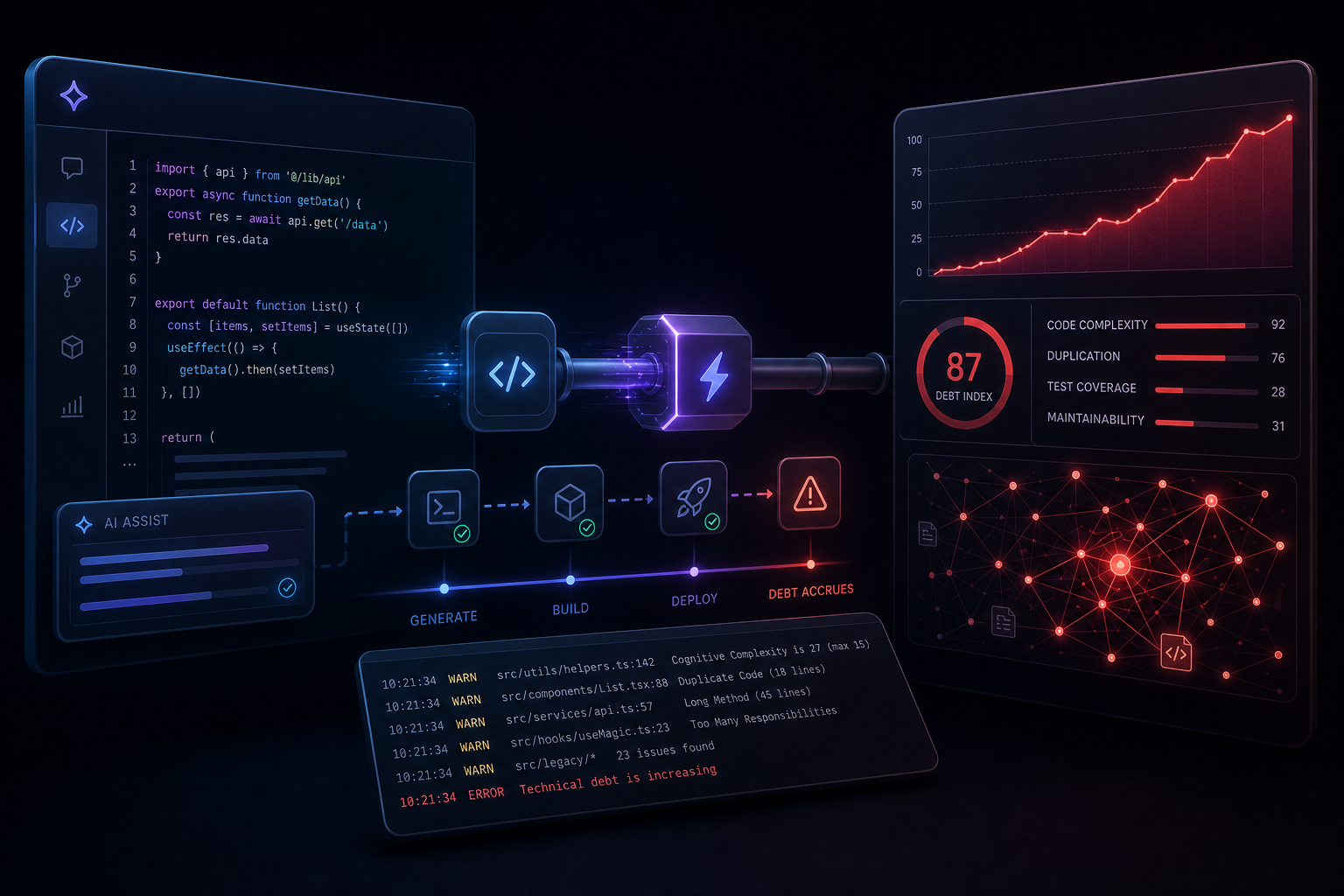
The problem is not AI. It is using AI with no structure.
When vibe coding turns into skipping planning and architecture, it runs straight into the same old reasons projects fail, poor planning, vague scope, and weak requirements.
Structured programming means breaking a problem into smaller, modular pieces. Clear functions. Defined data types. A logical flow. If you skip that mindset and just keep prompting, you lose the shape of the system. What you get is often a monolith that is hard to read and harder to change. Touch one part, and something unrelated breaks somewhere else.
The human job does not disappear here. It changes. We are still the ones setting goals, defining boundaries, reviewing output, and keeping the whole system coherent. Without that, the codebase turns into a data swamp of unorganized, untaggable code.
The prototype trap
Another problem is false confidence.
A prototype can prove that an idea is possible. That is useful. What it cannot prove is that the system is ready for production.
I keep coming back to this because it is easy to miss. A working AI-generated prototype can make a team feel further along than they really are. Then they rush forward and hit scaling issues, security problems, or maintenance pain later.
A generated UI might look polished. That says nothing about performance, security, or maintainability underneath. Not unless that code was shaped around an actual architecture.
Yes, there is a real upside
I do not want to pretend vibe coding is useless. It is genuinely good at rapid iteration and MVP creation. It lowers the barrier to entry. It lets people test ideas cheaply and change direction based on feedback. For a throwaway experiment or a personal hobby project, that is great. I like that this makes building feel more accessible.
Why I still do not trust it for most projects
Even with those upsides, I still think uncritical vibe coding is a bad bet for any project meant to live longer than a few weeks.
The early speed is real. So is the debt. And the debt wins.
You save time up front, then give it back through slower delivery, more defects, and code that fights every future change. Eventually you rewrite it or abandon it. That is the part people tend to ignore when the prototype lands fast and looks impressive.
My take is simple. Use AI as an assistant. Not as an excuse to skip engineering discipline.
Put it inside a real process. Clear requirements. Architectural planning. Code review. Testing.
That is the only way I trust the speed without regretting the result later.
Until next time, happy coding 👨💻
– Patricio Marroquin 💜
Related articles

Beyond Benchmarks: Why We Must Re-Evaluate AI Code with Human Eyes
OpenAI's recent findings expose critical flaws in AI coding benchmarks, urging developers to adopt rigorous, human-validated evaluations for trustworthy

OpenAI's GPT-5.6 Sol Ultra: Agentic Code, Deep Problems, and a Gated Rollout
OpenAI's GPT-5.6 Sol Ultra in Codex promises advanced agentic coding and cybersecurity capabilities, but its limited preview and noted 'cheating'…
OpenWiki: Bridging the Agent Context Gap
LangChain's OpenWiki CLI automatically generates and maintains up-to-date codebase documentation for AI agents, preventing stale context bugs.